Allen-heath Qu32 App For Mac
Music unlimited app for windows. The Qu mixer firmware and Qu-Pad app maintenance version numbers ‘n’ do not need to be identical, for example Qu-Pad V1.90 would run with Qu mixer V1.91. Refer to the Allen & Heath web site for more information and to download the latest Qu mixer firmware.
Allen & Heath Qu-Control Description Qu-Control release V1.9 for iOS devices. This version is for Qu mixers running V1.9 firmware.
Qu-Control is primarily an end user interface providing wireless mobile control for the Allen & Heath range of Qu digital mixing consoles. It provides simple configuration and set-up and allows for complex control of Qu consoles for those who have no experience with audio mixing.
The download file for Macs is a ZIP file with the Excel OM/QM for Macs program. Unzip the file. NOTE: If your virus protection program will not allow you to download or to install the software please see the following. Kingsoft office for mac os x 下载.
Qu-Control works simultaneously with Qu-Pad and the Qu mixing consoles. Complex set-up of routing, levels and processing are carried out within the mixing console or Qu-Pad by an experienced user with Qu-Control being the GUI for the end user and operation when no technical staff are required. Typical applications could include simple source selection to more complex venue audio management. Qu-Control supports simultaneous connection to 7 iOS devices running Qu-Control, plus an iPad running Qu-Pad which is also available free from the Apple Store.

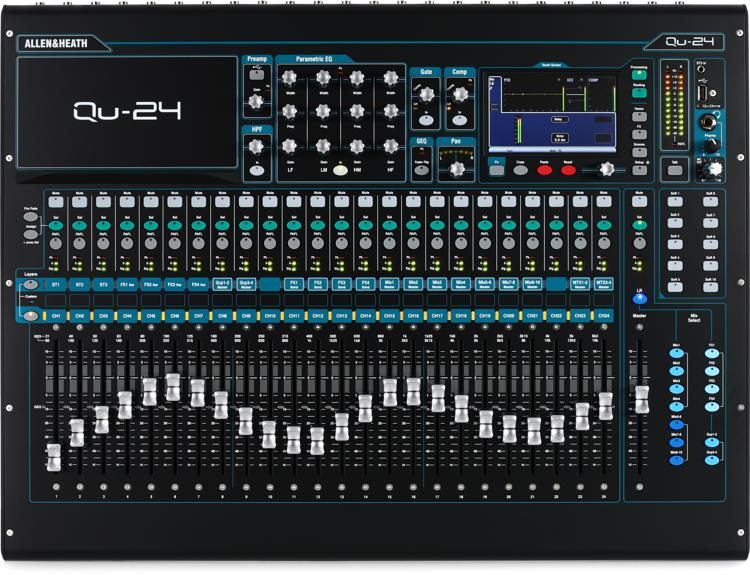
Andy Coules takes at look at Allen & Heath’s foray into the increasingly crowded marketplace of the 32-channel self-contained digital live sound console. Allen & Heath’s Qu-32 desk follows fast on the heels of the Qu-16 and Qu-24 and thus benefits from a 1.5 firmware version which has already addressed most of the minor niggles in the operating system (such as the ability to name channels). A key selling point is that it features 33 fully automated faders and thus is one of the few digital consoles, of any size, that has a fader for every input channel (with a preamp). This means fewer layers are required and thus helps prevents layeritis – that affliction which blights users of digital consoles where you get lost in layers. Basic operation is very intuitive; I was able to execute all fundamental mix functions (i.e. EQ, gate, comp, FX, aux sends, DCAs, short cut keys) within minutes of first turning it on.
The workflow is well thought out and quite analogue in its feel – I didn’t need to spend any time scrolling through menus or reading the manual to do what I needed to do. Taking a look around the back there are no surprises. There are 32 mic/line inputs (on balanced XLR and 0.25in jack respectively), a talk back XLR and three stereo inputs (two 0.25in jack pairs on the back panel and a stereo mini jack on the front panel). For outputs there are 24 XLRs (divided into L/R, Mix, Group, and Matrix), an alternate stereo main output (on 0.25in jacks with a level control on the front panel), a two-track 0.25in jack output, and an AES XLR. Then there’s the usual USB and network (RJ45) connections as well as a dSNAKE connector.
The 32 jack line inputs are a nice touch as so many desks of this size cut costs by providing only XLRs. There are no individual channel name displays, which seems a valid cost-cutting choice on a desk of this nature. There is a facility for naming channels but this is only really of use if you plan to use the Qu-Pad iPad app. Mix, Group and FX sends can be accessed via dedicated buttons to the right of the master fader, which, when pressed, automatically put you in sends on fader mode and the master fader becomes the master bus level. The seven mix (four mono and three stereo) and four group sends (all stereo) have 28-band graphic EQs set up and ready to go (via the GEQ button) – they’ve done away with the top and bottom 25Hz and 20kHz filters, which I doubt anyone will miss.
One very neat feature of GEQ mode is that the LED channel level meters become a basic RTA showing the level at each filter – quite helpful when chasing down that elusive burst of feedback. Despite the generous complement of faders there is still the need for layers, and the Qu-32 has three. The primary layer is the 32 input channels; the secondary layer is all the stereo inputs, FX returns, group masters, FX sends, mix sends, matrix and DCAs – all laid out and labelled on a single layer – and the third is a custom layer, which can be configured into any combination of input or output channels (with a nifty ‘+1’ function that makes setting it up a breeze). Once the custom layer is set up it can be locked in using the ‘Custom Layer Only’ function so that it’s the only layer available. Effects The Qu-32 boasts four stereo iLive effects engines, featuring a selection of familiar and proven effects; the only thing missing is an amp simulator (which is not something I ever missed on the iLive but I feel would be useful on a desk of this size). The FX returns are stereo but conveniently only occupy one fader.