Format Flash Drive For Windows Mac
Reader Dan Coates believes in recycling (or, at least, reformatting). Table of contents on word for mac. He writes: I have a number of commercial flash drives with outdated information. How can I unlock them for reuse? Increasingly, companies are putting data on cheap USB flash drives and passing them along to customers and colleagues. Like you, I agree that it’s a shame to toss them out when you can easily reformat them and put them to use for your own purposes. The easiest way to reformat one of these things is to launch Disk Utility (Applications/Utilities), select the flash drive from Disk Utility’s list of drives, click the Erase tab, choose MS-DOS (FAT) from the Volume Format pop-up menu, and click the Erase button.
The drive will be erased with the selected format and will be usable on both Macs and Windows PCs. I’ve seen claims on the Internet that formatting these drives in the Mac OS Extended (Journaled) format speeds up transfers. I haven’t found that to be the case.
In fact, when copying a 2GB folder to a SanDisk U3 Cruzer Micro USB flash drive I found the opposite to be true. It took 7 minutes and 42 seconds to copy the folder to the drive when it was formatted using MS-DOS (FAT) and 8 minutes and 27 seconds when the drive was formatted using OS X Extended (Journaled).
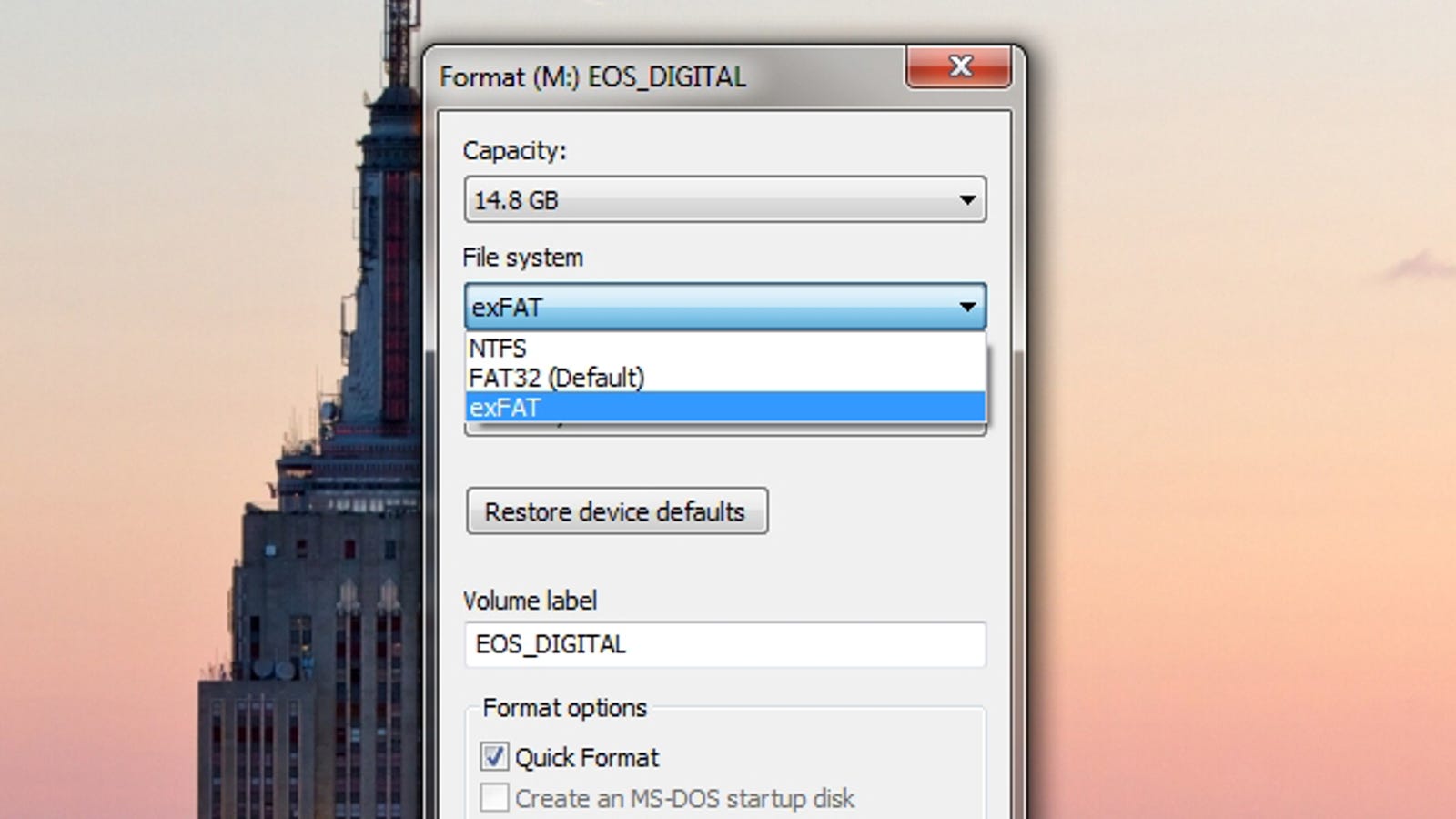
(Note: Windows 10 limits FAT32 to 4GB. I recommend using exFAT instead, which is essentially a newer version of the same format.) assign. Assigns the disk a drive letter. Exit to quit. If you're still having problems with the disk after trying this, you might try omitting the quick from step 9 to do a full format. That will take a very long.
When copying that same folder from the flash drive to my hard drive the two were close—1 minute 36 seconds for the OS X Extended format and 1 minute and 40 seconds for the MS-DOS format. Should you desire to format the drive as Mac OS X Extended (Journaled), you’re welcome to. To do so, select the drive in Disk Utility, click the Partition tab, select 1 Partition from the Volume Scheme pop-up menu, click the Options button, choose GUID Partition Table or Apple Partition Map from the resulting sheet (GUID for Intel Macs or any Mac running 10.4 or later or Apple Partition Map for PowerPC Macs running any version of Mac OS X), and click OK. Choose Mac OS Extended (Journaled) from the Format pop-up menu and click the Apply button. In the sheet that appears click the Partition button and your flash drive will be formatted as a Mac OS X Extended (Journaled) drive.
This Video Capture as Mac allows for you to Record Video on Mac and change cover capture video to various data formatting* (WMV, MPG, MP4, AVI, 3GP Rather than, this feature-rich projection screen Recorder for Mac will make it attemptable to merge multiple lodges into How to record video on. Record video on mac for youtube.