How To Make A Row Into A Column In Excel For Mac
How to Transpose Data in Excel: Turn Rows into Columns (vice versa) Written by co-founder, Microsoft Office Specialist. Reorganizing data in a spreadsheet can be a pain. Especially when you have to make big changes that a won’t fix. One of the common tasks that fall into this category is transposing: ie. Turning rows into columns (or columns into rows). Without any special help from Excel, that takes a long time! But Excel has some built-in transposing capabilities that make the process easier 🙂 Let’s take a look at turning rows into columns (and vice versa) in Excel, as well as a few of the things you’ll need to keep in mind when you do so.
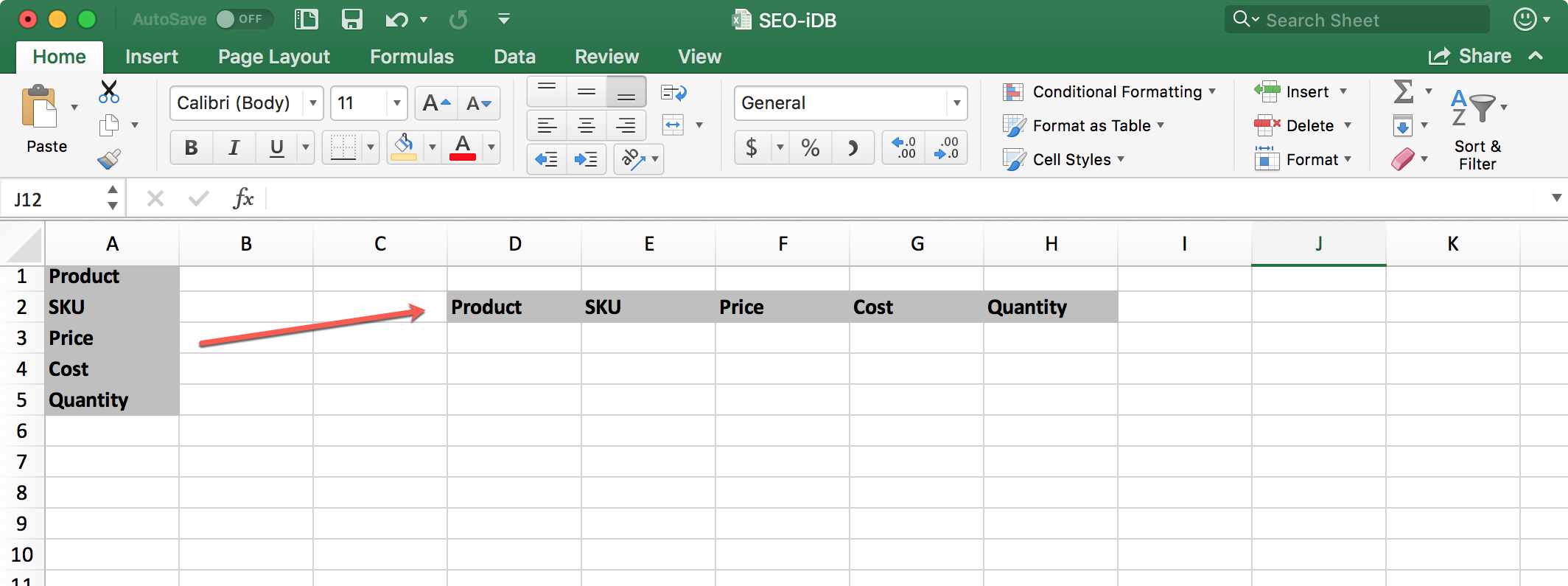
Before we start, let’s make sure we know exactly what transposing is. In short, transposing is taking a row and turning it into a column, or a column and turning it into a row. Install citrix receiver mac. Some people call this “rotating” a row or column. The leftmost cell in a row will always become the topmost cell in a column, and the topmost cell in a column will always become the leftmost cell in a row. This ensures that column and row labels are always in the right place.
There are a couple ways we can transpose data in Excel. Before we get into them, grab the free sample workbook so you can try it yourself! This is because of the relative cell reference. Instead of interpreting the command as adding cell G1 for the extra fee, Excel instead interprets it as summing the cell that’s three to the right and one up, or three to the right and two up, and so on.
When we transposed the data, we also transposed the reference. So instead of looking at G1, our new totals are looking at A13. Fortunately, there’s an easy way to fix this: with. Let’s go back to the original Total column and make some adjustments. The first total is derived using this formula: =SUM(A2,G1,(A2*B2)) By changing G1 to $G$1, we can tell Excel that we mean that specific cell, and not the cell three to the right and one above the cell we’re working with. As you can see, it worked this time.
Excel knows that our extra fee is in cell G1, and that it’s always going to be in G1. You don’t need to worry about relative and absolute references using the TRANSPOSE function, because it automatically pulls the values from the previous location. To see how this works in this particular case, we can use the TRANSPOSE function to transpose these columns into rows. Use the method above to transpose this data with the TRANSPOSE function (I placed it just below the copied and pasted version).
It is suitable for anyone who uses Excel on a Mac for databases. Splitting one column of text into two or more columns (Convert Text to. Rows in the column. Instead, I want to have the Company names display vertically in Column A and the Data Attributes display horizontally in Row 1. This would make it easier for me to do comparisons and analysis. For example, I can’t easily filter the spreadsheet for vendors in CA. How to Transpose Columns & Rows in Excel, Open the spreadsheet you need to change.
Now, try changing one of the interest values in the original data. I’ll change the 0.07 to 0.09 and hit Enter.