
Java Se 6 Runtime For Mac Osx 10.7.5 Download
Apple Java for OS X 10.6 Update 16 delivers improved security, reliability, and compatibility by updating Java SE 6. Apple Java for OS X 10.6 is an Apple vetted Java environment, designed to be as highly integrated as possible within its own operating system.
With Oracle’s Java 8, there’s been some confusion as to whether Java 8 runs on Mac OS X 10.7.5. This issue was lent additional urgency in the wake of Oracle’s announcement that.
The root of the confusion lies in the fact that Oracle has listed two different sets of system requirements on their website for Macs running Java 8 on Mac OS X. The first set is available via Oracle’s general.
VLC Media Player 3.0.4 - Popular multimedia player. Download the latest versions of the best Mac apps at safe and trusted MacUpdate. VLC Media Player is a highly portable multimedia player for various audio and video formats (MPEG-1, MPEG-2, MPEG-4, DivX, MP3, OGG.) as well as DVDs. App name: VLC media player. App description: vlc (App: VLC.app). If the screen prompts you to enter a password, please enter your Mac's user password to continue. When you type the password, it won't be displayed on screen, but the system would accept it. 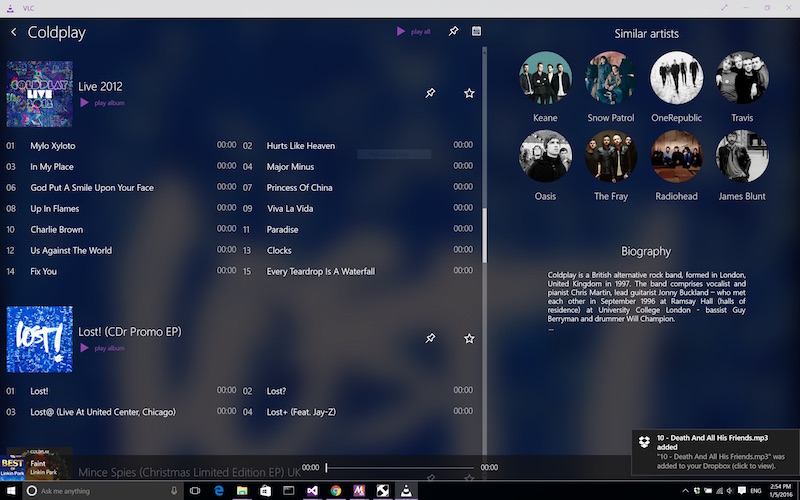 VLC Player for Mac Screenshots. Screenshots are not available for this software. VLC (initially VideoLAN Client) is a highly portable multimedia player for various audio and video formats (MPEG-1, MPEG-2, MPEG-4, DivX, mp3, ogg, avi) as well as DVDs, VCDs, and various streaming protocols. VLC media player is not just for video playback however. It also offers superb integration with video channel streaming services such as Channels.com giving VLC media player is the universal tool that handles all types of media files. I have tried to play some videos on my mac but the format was not. VLC (initially VideoLAN Client) is a highly portable multimedia player for various audio and video formats, including MPEG-1, MPEG-2, MPEG-4, DivX, MP3, and OGG, as well as for VLC is always one of the first apps I download on a fresh Mac installation. Highly recommended. Reply to this review.
This page states that Java 8 requires the following: • Intel-based Mac running Mac OS X 10.8.3+, 10.9+ • Administrator privileges for installation • 64-bit browser The second set is available via the. The linked from the download page state that Oracle’s Java requires the following: • Intel-based Mac running Mac OS X 10.7.3 (Lion) or later. • Administrator privileges for installation • 64-bit browser In short, the question of Java 8 support for 10.7.x depended on which system requirement page was correct. For more details, see below the jump. Based on my testing, it appears that the current version of Java 8 () installs on Mac OS X 10.7.5 without issues. Following installation, I tested on a 10.7.5 Mac against the following sites: My work’s Juniper VPN (which uses a signed Java applet) Oracle’s Java Test page: Java Tester’s Java Version page: In all three cases, the Java applets on those sites launched and worked without issue using (though the needed to be.).
I've installed JDK 7u7 downloaded from oracle's website. But after installation, the terminal is still showing java version 6 $java -version java version '1.6.0_35' Java(TM) SE Runtime Environment (build 1.6.0_35-b10-4) Java HotSpot(TM) 64-Bit Server VM (build 20.10-b01-428, mixed mode) any idea why java 7 is not showing up? Ans: OK, the problem has been resolved. Here is the answer: I found that my Terminal has a.bash_profile and the java home variable is set to 1.6 export JAVA_HOME='/System/Library/Frameworks/JavaVM.framework/Versions/1.6.0/Home' So this is the line causing the problem every time I opened a new terminal window.
Mac g5 case. Simply remove this line will solve the problem. You still need to follow what @aleroot said, but if that doesn't work for you, check the.bash_profile (or.bashrc) setting file to see if you've previously exported any java version. Oracle's installer puts java inside the /Library/Internet Plug-Ins/JavaAppletPlugin.plugin. And it doesn't overwrite /usr/bin/java. So, if you issue a whereis java in the terminal, it'll return /usr/bin/java. (which in turn points to /System/Library/Frameworks/JavaVM.framework/Versions/A/Commands/java, which is Apple's 1.6 version).
So, if you want to use the new java version, replace the /usr/bin/java symlink so that it points to /Library/Internet Plug-Ins/JavaAppletPlugin.plugin/Contents/Home/bin/java instead: sudo rm /usr/bin/java sudo ln -s /Library/Internet Plug-Ins/JavaAppletPlugin.plugin/Contents/Home/bin/java /usr/bin. Vi ~/.bash_profile add export JAVA_HOME=`/usr/libexec/java_home -v 1.7` This tells your /usr/bin/java link target to use the latest Java 7 Package installed in /Library/Java/JavaVirtualMachines/ So for JDK 1.7.0_17 JAVA_HOME would be: /Library/Java/JavaVirtualMachines/jdk1.7.0_17.jdk/Contents/Home Note: There were a lot of change in this area recently to move Mac OS X from Appels own System integrated Java packages to Oracle based Java Packages. The above solution is working fine as of Mac OS X 10.8.2. +1 for this answer which is imo the correct one because it works on versions of Mac OS before and after 'Java Preferences' was removed, and by showing the '-v' option it demonstrates how you can use java 6 even if java 7 is installed (which is what I want). Hence on my Mac running Lion (10.7.5) I use the same command with '-v 1.6'. This is crucial because I need Java 6 and Oracle doesnt provide one for Mac OS - only Java 7, and this allows me to use the installed JAva 6 even though Java 7 is installed. – May 20 '13 at 11:43 •.