Adobe Flash Player For Google Chrome On Mac
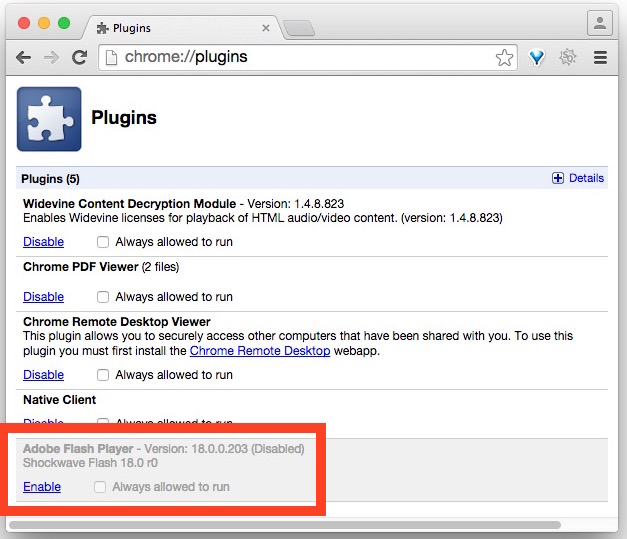
Sep 7, 2018 - Google Chrome Settings Not Allow Adobe Flash Player Plugin To Run Automatically. Categories:BetaMacReport an Issue. Adobe (creator of Flash) in conjunction with all major browsers, has announced to end-of-life. Enable Adobe Flash Player on Firefox Enable Adobe Flash Player on Opera Enable Adobe Flash Player on Edge Enable Adobe Flash Player on Chrome 1) Open your Google Chrome browser, type chrome://settings/content in the address bar and press Enter. 2) On the content settings screen, locate Flash player settings. Select Allow sites to run Flash, then click Done to save the change.
Follow up on my previous note describing a functional solution to the Flash Player problem. Following the aforementioned procedure the following files were added in ‘MacIntosh HD/Library/Internet/PepperFlashPlayer’. In the PepperFlashPlayer folder are manifest.json (the script for PFP) and PepperFlashPlayer.plugin.
The later contains the terminal line ‘ HDP-MacBook-Pro-1201:PepperFlashPlayer.plugin hportnoy$’. I’m running on El Capitan (v 10.11.6). Hope this helps out the gurus in finding a better solution. Anthony Laforge (Google) 8/9/2016, 21:17 น.
This article applies to only managed versions of Chrome Browser. Chrome OS comes with Flash built-in, and Flash cannot be uninstalled on Chrome OS devices. Important note: Adobe has the deprecation of Flash Player for December, 2020 and will be turned in Chrome in July, 2019. We strongly encourage customers to migrate to alternative solutions. By default, Chrome installs Adobe Flash Player in the background or the first time that a user encounters Flash content, and Chrome will continue to update Flash Player via the. For most organizations, we recommend you use the default settings. However, some IT admins may want to manage their users’ Flash experience.
Flash deployment recommendations for IT admins You have two options: Option 1: Allow Chrome to manage its version of Flash Player (recommended) Keep the Chrome Component Updater enabled (default). In Windows Group Policy Editor, set =true. Chrome will download and install Flash Player and update it as needed. OR Option 2: You own the responsibility of updating Flash Player for your users.
Manually install and manage your company's installation of Flash via the Adobe Flash Player MSI (for Chromium). • Disable Component Updater by setting =false.
• Download and deploy Flash to your users via the (be sure to select “Opera & Chromium PPAPI MSI”). • Continue to update Flash for your users via the Adobe Flash MSI every time an update to Flash is released.
In this case, Google Chrome will not update Adobe Flash Player-- all updates are done manually by the IT admin (for example, re-deploying Adobe Flash Player updates via Adobe's newer MSI packages). If the Component Updater is left enabled, Chrome will choose to use either the Adobe Flash Player MSI dll or the Chrome plugin (whichever is newer).
Warning: Do not disable the Component Updater using the policy without deploying the Flash MSI to your users. If you do this, Flash will fall out of date (as no updates will be installed from Google if Component Updater is disabled).
This could leave Flash open to potential bugs and security issues. If Flash falls too far out of date, Chrome may block the outdated plugin. To verify what version of Flash Player is running on Chrome (for both Options 1 & 2 above) -- go to chrome://version to see what version is installed.
Note that if the update is delivered by the component updater (Option 1) a restart is needed for Linux and Chrome OS (not for Windows or macOS). If updating using the Adobe Flash Player MSI (Option 2), restarting Chrome for all platforms is necessary. Manage Flash by policy You can manage how Flash playback happens using the policy as well as. If these policies are not configured, Chrome will require users to activate Flash for each site that requires Flash that they visit. Starting with Chrome 62: To minimize user impact and retain Flash functionality, you can whitelist internal and trusted sites that your users regularly access or and to allow Flash to play automatically. Microsoft word for mac misspelled word, no option to add autocorrect.. However, this is generally not recommended for security reasons.
Note: You should whitelist specific URLs by using PluginsAllowedForUrls as opposed to the broader wild card mentioned above. • - This whitelists certain URLs to automatically run Flash. You can enable internal Flash applications and sites that you trust by creating whitelists such as ['[*.]mycorp.com', 'play.spotify.com'].
Shortcut for mac photoshop eye drops. However, there are hundreds of them; a daunting task, plus most artists’ brains are visually oriented; they like to see and click on things and it’s perfectly acceptable to do so. Some people consider mastery of Keyboard Shortcuts essential for professional imaging artists and believe that it’s mandatory to memorize and use them.
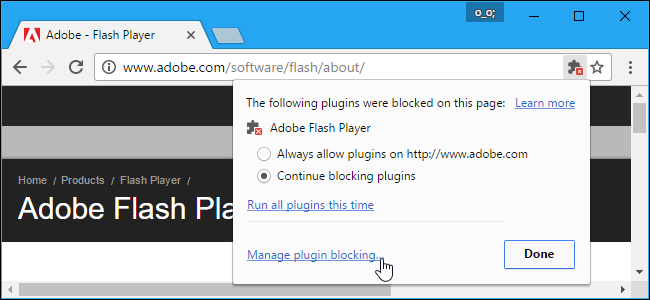
• - This blacklists certain URLs from accessing Flash content such as ['flashvideosite.com']. Note: The Chrome policies DefaultPluginsSetting, PluginsAllowedForUrls, and PluginsBlockedForUrls only affect the Flash plugin and not any other plugins. When DefaultPluginsSetting='3' ('Flash - Ask first') is selected, users may need to click on Flash content and Allow it to run for that site first. With this setting, your user may see 'Click here to Install Flash!' After the user clicks the link, they can click Allow. Note: Starting in Chrome 62, Option 3- 'Click to play' is no longer an option. Alternatively, your users may see a gray box with a puzzle piece and the error “Click to enable Adobe Flash Player.” • Click the gray box that says “Click to enable Adobe Flash Player.” • In the box that appears in the top-left, click Allow to run the Flash plugin.